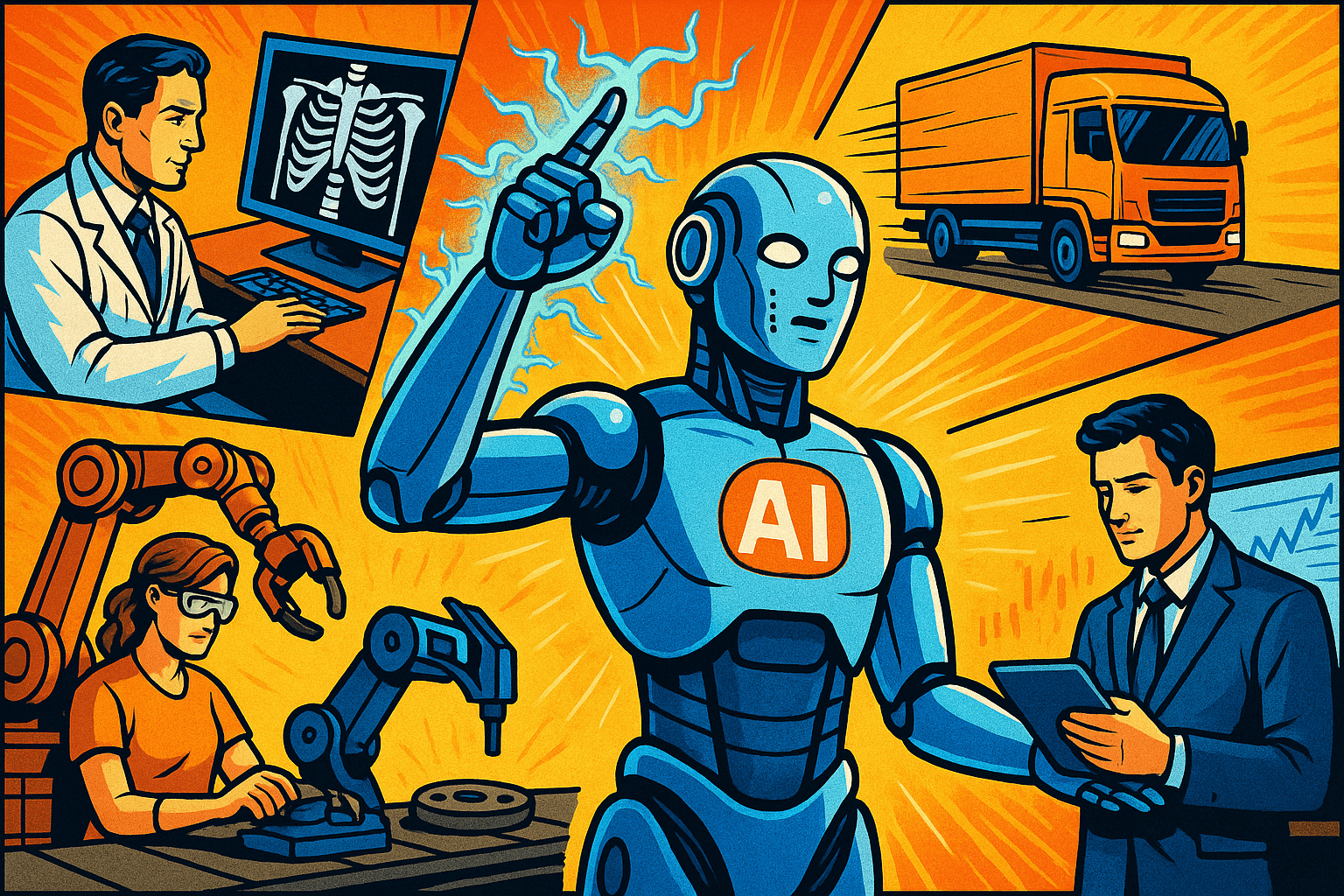
Why Every Business Needs AI: A Designer's Take on the Future of Work
I've been designing products for over a decade, and I've never seen a shift quite like this one. Artificial Intelligence isn't some far-off concept anymore. It's here, sitting at the intersection of design, strategy, and execution. And honestly? It's changing everything about how we work.
When I first started incorporating AI into my design process, I was skeptical. I thought it might strip away the human elements that make good design resonate. But I was wrong. What I discovered instead was a powerful collaborator that could handle the heavy lifting while I focused on what humans do best: creativity, empathy, and storytelling.
The Reality Check
Let me be straight with you. If your business isn't exploring AI right now, you're already behind. I don't say that to sound alarmist. I say it because I've watched competitors leapfrog established companies simply by being smarter about their data, faster with their customer service, and more precise with their marketing. AI has moved from being a nice-to-have to being absolutely essential. It's not about replacing people. It's about giving people superpowers. Think of it as the difference between sketching with a pencil versus having access to the entire Adobe Creative Suite. Both have their place, but one dramatically expands what's possible.
Where AI Actually Makes a Difference
Let me walk you through the areas where I've seen AI create real, tangible impact.
Making Sense of Data
As a designer, I used to rely heavily on intuition. And intuition is still crucial. But now I can back up that intuition with hard evidence. AI processes user behavior data, interaction patterns, and conversion metrics faster than any team could manually analyze.
I recently worked on an e-commerce redesign where AI helped us identify a checkout flow issue that was causing cart abandonment. The pattern was subtle, hidden in thousands of user sessions, but AI surfaced it within hours. We fixed it, and conversion rates jumped by 23%. That's the kind of insight that used to take months of A/B testing to uncover.
The beautiful thing is that this applies across every department. Sales teams can predict which leads are most likely to convert. Operations can forecast inventory needs with scary accuracy. Finance can spot risks before they become problems. It's pattern recognition at a scale humans simply can't match.
Reimagining Customer Service
I'll admit, when chatbots first appeared, they were terrible. Robotic, unhelpful, frustrating. But modern AI-powered support systems? They're genuinely impressive.
I designed the UX for a customer support platform last year that integrated AI assistants. These weren't just canned response systems. They understood context, learned from conversations, and could handle genuinely complex queries. The result? Response times dropped from hours to seconds, customer satisfaction scores climbed, and the human support team could finally focus on cases that actually needed human judgment and creativity.
What strikes me most is the scalability. A single AI assistant can manage hundreds of conversations simultaneously without breaking a sweat. During peak periods or product launches, this capability becomes invaluable. The system doesn't get tired, doesn't need coffee breaks, and maintains consistency across every interaction.
Precision in Marketing
As someone who creates experiences, I've always believed that personalization is key to good design. But personalizing at scale used to be impossible. AI changed that equation completely.
Now we can deliver tailored content to thousands of users based on their individual behaviors, preferences, and needs. The AI analyzes what resonates with different segments, predicts what users might want next, and adjusts campaigns in real time based on performance data.
I worked with a retail client who implemented AI-driven email marketing. Instead of sending the same generic newsletter to everyone, the system generated personalized product recommendations for each subscriber. Open rates tripled. Conversion rates doubled. The ROI spoke for itself.
But here's what really matters from a design perspective: this kind of personalization makes users feel seen and understood. It transforms generic brand interactions into genuine, relevant conversations. That's powerful.
The Investment Mindset
Let's talk honestly about costs, because this is where many businesses hesitate. Implementing AI isn't cheap. You need the right technology stack, you need to train your team, and you need to integrate everything with your existing systems. It requires time, money, and patience.
But here's what I tell my clients: think about this as building infrastructure, not buying a tool. You're not just purchasing software. You're fundamentally upgrading how your business operates.
I watched a mid-sized company invest heavily in AI automation last year. The first six months were rough. There were integration challenges, learning curves, and moments of doubt. But twelve months in? Processes that used to take their team two weeks now take two hours. Their team isn't working less. They're working on higher-value problems. Strategy instead of data entry. Innovation instead of repetition.
That's the real transformation. AI doesn't replace human work. It eliminates the tedious parts so humans can focus on the interesting parts. As a designer, this has freed me to spend more time understanding user needs and less time formatting spreadsheets.
The Learning Curve
One aspect of AI that fascinates me is how it gets better over time. Unlike traditional software that stays static until you update it, AI systems continuously learn and adapt. They improve with every interaction, every data point, every outcome.
This means the business that implements AI today isn't just getting today's solution. They're investing in something that will become more valuable, more accurate, and more useful as time goes on. It's like compound interest for your operational efficiency. I've seen this firsthand with recommendation engines. The first month, they're okay. Six months in, they're good. A year later, they understand your users better than you do. That evolutionary capability is unprecedented in business technology.
My Honest Take
Look, I'm not here to sell you on some utopian vision where AI solves every problem. It won't. There will still be challenges. There will still be failures. There will still be moments when human judgment is absolutely irreplaceable.
But having worked in this space for years now, watching businesses transform themselves through intelligent technology, I can tell you with certainty: the future belongs to companies that embrace this shift.
Sundar Pichai once said, AI doesn't just replace humans. It amplifies our creativity and efficiency. From where I sit as a designer, that's exactly what I've witnessed. My best ideas come from the unique collaboration between human intuition and machine intelligence.
The businesses winning today aren't choosing between human expertise and artificial intelligence. They're combining both. They're using AI to handle the complexity, the scale, and the speed, while empowering their people to focus on creativity, strategy, and genuine human connection.
That's not the future of business. That's the present. And if you're not already on this path, now is the time to start.
Because in a world where every touchpoint, every transaction, and every transformation is getting smarter, the question isn't whether you'll adopt AI. It's how quickly you can make it work for you.